Showing posts with label SPECIAL POST. Show all posts

Wednesday, January 2, 2013

Silvia Bianchi


Silvia Blanchi is a 28-year-old artist originally from Pisa Italy, now living in Stockholm. She graduated with a bachelor and an MA in Semiotics in Italy. Silvia does an amazing amount of great projects, from fashion to digital art, installations and publishing. Her boyfriend Ricardo Juarez is her work partner; the couple is behind the art project and tumblr Barriobajero. I interviewed Silvia about her different projects and her wonderful sense of aesthetic. See more;

▼ Read the interview ▼

Dora Moutot (DM) interviews Silvia Bianchi (SB)

DM: Let’s talk about Shallowww, your online clothing store! Where do you find your design inspirations?
SB: We are actually three people working at Shallowww. I just designed the first sweater, the Internet one which turned fast into a best seller. Then we decided to create a brand out of it. Our inspiration comes from the Internet and its semiology. Our aim is to translate the 2.0 aesthetic and the digital imagination that surround us to textile production. We ironically play with the cold essence of technology making warm sweaters and apparel.

Shallowww Clothing only distributes online and diffuses its products like memes that is pretty consistent. The collection is limited and printed on demand, respecting ethical and local production standards. We only produce in Spain and Italy.
DM: One of your designs is an Arabic typographic print on a t-shirt. It reminds me of an article I wrote about “the muslim trance” tumblr trend.  http://www.lagazettedumauvaisgout.com/original/trend-muslim-trance/?lang=en
SB: I read that article and I loved it! We are expanding our symbols research to other alphabets and codes, we are fascinated by our generation trend to take religious symbols and contemporary logos and mix them all together, just caring about how they look and not about what they mean. The funny thing is that the Arabic word on the long sleeve shirt means Logotype but we didn't tell it on the website and we got a lot of emails from people afraid of what it says. It was a nice experiment.


DM: Why do you think this Arabic typography is so appealing right now amongst the Tumblr teenagers? Why did you decide to use it?
SB: Well I think its maybe because of artists like M.I.A, Fatima Al Qadiri or Slavs and Tatars, I was actually preparing a Vj Set for Fatima Al Qadiri when I began to make stuff with Arabics symbols. Trends grow and raise trough images feed nowadays, just think about how social network have changed in the last few years and how Instagram or Tumblr work. Now we just look at images, we get on touch with them trough fast feeds and we get fed up fast with visual inputs. We just look at the signifier but we have no time go to trough the signified, we recognize something as cool because we have seen it before, its a sort of digital memory game. We could define this trends as visual isotopies, basically forms that our brain recognize as redundant and begin to like, I think this is the reason why Tumblr has influenced our imagination that hard.


DM: How do you feel about tumblr trends? Do you think they affect the mainstream fashion world? How do you think the Internet and the digital are going to change fashion?
SB: They already changed fashion world. Jeremy Scott was just the first one who copied what internet artists have been doing during the last years five years and there are loads of brands that like Shallowww are inspired by this baroque 2.0 aestethic. Also art and fashion distribution have changed a lot during the last years, you can make an artwork and diffuse it like a meme all over the world and the same with a sweater or a t-shirt.


DM: Your also create very surrealistic installations. Can you tell us a bit about Caravanart?
SB: Caravanart was an amazing experience. We visited three different cities and had the chance to interact with three completely different landscapes and crowds. Talking about images feeds thay had big influence on my work. I remember that I had a sort of visual obsession for mylar sun shades when I was in Zaragoza, I made this internet reasearch http://advancedimagesearch.tumblr.com/page/12 and then I got one to in a shop. I worked mixing digital video and objects I found in the derelict places I visited.


DM: Your work seems to be quite focused on creating digital textures. We can see it your installations but also in your videos such as One-minute suit, or in the artwork you produced for your own fanzine called “awkward surface”. What is the inspiration for these textures? What kind of software do you use? How do you create them?
SB: I create them with Photoshop mostly, I generally take pictures or video frames and then Photoshop them to get digital/analog textures. Nature and surfaces are my main inspiration. I use water, stones and minerals.
DM: There is an 80’s/90’s kind of feel in your work. Does a particular art movement in time inspire you? Memphis Milano maybe?
SB: Definitely. I'm a such a big fan of Sottsass, Mendini and Du Pasquier. A couple of years ago I made a tribute to their work for the Reggio Emilio Museum “Spazio Gerra”. Memphis has a strong influence on my work when it comes to textures and patterns.


DM: Barriobajero is the project you’re doing with your boyfriend, Ricardo Juarez. What is this project about?
SB: Barriobajero is an art platform and experimental creative collective established in early 2010. We’re dedicated to curating, art direction, design, events and consulting services like fashion stylism. We are currently based in Stockholm, working as resident curators at Revenue S:T 79, a new studio/gallery space/club/ we recently opened in the city center. Our other ongoing projects include Shallowww and the self-publishing event series Stacks.
DM: Favourite blogs?

DM: Artists we should know about?

DM: What are the 3 favourite books/ fanzines/ magazines that you possess?
SB: The Most Expensive Restaurant Ever Built - SHP4


Interview by Dora Moutot for Triangulation Blog - January 2013 
Dora Moutot is a young journalist specialized in fashion within the digital culture. She is the founder of La Gazette du Mauvais Gout where she writes about bad taste, eccentric and kitsch trends. www.doramauvaisgout.tumblr.com


Monday, December 3, 2012

Masha Reva


Masha Reva is a 25-year-old fashion designer originally from Odessa, Ukraine. She graduated from the Kiev National University of Technology and Design with a MA in fashion. She is now living in London, studying Women’s Wear at Central St Martins. Her new collection in collaboration with Syndicated of Kiev is called Botanical Layers. The collection is inspired by nature and GUI from Photoshop. The prints are juxtaposing social networks and natural environment creating a metaphorical botanical garden of Photoshop layers and loading bars. See  more;

Dora Moutot (DM) interviews Masha Reva (MR) / Click imges to enlarge
Sweatshirts of the collection are available on sndct.com

DM: Hi Masha!
You explained that the visual stream of information on social network and blogs inspired your previous very opulent ” Merging 2012” last collection. Were the prints made of Internet images that you recycled? How did you work on this previous collection?
MR: The project started at was a time when my friends and I were in the need for some crazy projects without any boundaries. We created more of an art concept than a fashion lookbook. My idea began from a book I found while I was in New York. The concept came together with the help of this book and images found on the Internet. I created the textile prints and we organized the shooting in details with the help of Julie Pelipas, an amazing stylist.

(Image below is from the previous collection, see the whole MERGIN collection here)


DM: In your new collection “Botanical layers”, you seem to be inspired by the Photoshop interface. How important is the Internet and the computer in your work? How do you use both?
MR: Well, the Internet, Photoshop and I are totally inseparable! That is probably why I think in computer-ish way so much. But it also worries me: the relation to the to virtual world and the separation from the reality. I design all my textile prints in Photoshop and when I do, I try to not check my Facebook page. Big effort!


DM: The idea of using the computer interface is an emerging trend in art (http://rhizome.org/editorial/2012/ aug/3/interface-aesthetics). Is your collection an attempt to adapt this art trend into fashion or is it a coincidence?
MR: It is well known that all thoughts are in the air. In my opinion this idea of integration of computer interfaces in our everyday life and furthermore in clothes is very natural. It is all about us, our generation, it’s happening here and now.


DM: It’s the first time that I see a collection taking inspiration of the Internet and computer in such a sophisticate and beautiful way. Usually it’s always used in a very 90’s voluntary tacky kind of way. What was the inspiration for this collection? Why did you mix digital aesthetics with romantic flower prints?
MR: I imagined my own hero. My hero would be walking through beautiful botanical garden; his/her clothes would be reflecting the mood of the time. The prints look like a quick mood-boards made with help of computer. The collection emphasizes on our relation to nature today. I have a nostalgic perception of it.


DM: How do you think the Internet and new technologies are going to transform fashion?
MR: Fashion has always been reflecting the world and its mood and it will keep doing it forever. In Fashion history books in the future, our generation will be mentioned as the Internet-generation. Hard to say in which way transformations are going to be felt and seen. There is already a big influence of the virtual in the way we are now presenting and buying fashion collections.


DM: Favorite blogs?
MR: I am not so much into blogs but I like to check this one: http://psycheau.tumblr.com/


DM: What’s next for Masha Reva?
MR: To get as much as possible from my student experience in London!


Interview by Dora Moutot for Triangulation Blog - December 2012 
Dora Moutot is a young journalist specialized in fashion within the digital culture. She is the founder of La Gazette du Mauvais Gout where she writes about bad taste, eccentric and kitsch trends. www.doramauvaisgout.tumblr.com


Wednesday, August 8, 2012

Manon Kündig


Manon Kündig is a 29-year-old Swiss fashion designer who very recently graduated from the Antwerp’s Royal Academy of Arts. Her master 2012 graduate menswear collection called ” Bowerbird” is full of digital prints and acid colours. Photoshop is probably one of the most important tools of her collection and she confesses being completely addicted to online research. Like the bird, she was inspired by to create her collection, bird stealing rubbish to create its nest; Manon stole Google images to create her prints. We asked Manon about her work and the relationship between the Internet and her collections. See more;

▼ Read the interview ▼

Dora Moutot (DM) interviews Manon Kündig (MK) / Click imges to enlarge_

DM: You just graduated from the MA fashion design of the school of Antwerp. How many years did you study? How was it studying in Antwerp and having Walter van Beirendonck as a teacher?
MK: It was really nice to study in Antwerp. I did the 4 years course in 5 years because I did somehow lose sight of my priorities due to love and fun. Studying seems like having a full time job, but I like to be versatile and still have a life. There is no way for me to be completely dedicated to my work in an academical way. I think this was my strength. Also I have a really lazy side that I fully love and accept. I mean lazy in action not in brainwork. Or maybe better said; going out can still be considered as work for me. I was lucky to meet teachers that could understand my different way of dealing with planning and leaving me free (not without worries) to do my thing. Walter is a great mentor. He gave me lots of motivation. Dirk van Saene also had a great input and I really enjoyed the complete freedom and trust of this final year. I think this school makes you definitely strong and makes you believe in your capacity. I also need to add that studying in Antwerp stays really democratic. The fee is low in comparison to other “top” schools and the quality of life is mild.


DM: Your collections are always very surreal and theatrical. What is your fantasy world about? Where do you get your inspirations?
MK: My inspiration comes from things I live or discover. I mainly need to be fully convinced, intrigued and passionate about a topic.


DM: I read that you were inspired by mohair fetishism while designing a micro- collection during your time at school. To me, your BA collection Blowjob looked like it was inspired by inflatable fetishism and black metal culture and your MA collection called Bowerbird looked very inspired by the digital art niche and the actual Internet aesthetic. You work seems very inspired by fetish, niche and alternative culture. Do you research these cultures online?
MK: You are completely right and I am completely addicted to online research. You must agree it is extremely comfortable. Surfing is the only sport I practice. My ass is made to sit. My back has slowly a bump. I even got a nerve blocked in my left wrist because of my position while smoking and using the computer. Fetish and “subcultures” are indeed giving me a great source of motivation and fascination. I do like the particular and hope being particular myself too.


DM: Why did you call your last collection Bowerbird? What is the story behind the collection? And why do you choose to do menswear?
MK: I do menswear because it is easy. Or maybe I can't really handle the female fashion world as it exists. It would be a really different approach. I am actually slowly feeling ready for it.

A Bowerbird is a bird. I did discover it thanks to David Attenborough, (this bird)  It was too good to not be used. It gave me so much freedom. I could act like a bird and make a collection where everything is possible and imaginable. The aesthetic of the bird has no hierarchy. Rubbish can be beauty. A cocktail. The bird picks whatever is in his surrounding. It is what I did or always do. Therefore there are lots of stolen google images. The Bowerbird is a commune looking small brown bird acting like a peacock with his material goods. This behaviour is really close to the macho-male showing off his car and t-shirt with a brand-tag. I live in this kind of neighbourhood. Borgerhout. Borgerhout is called borgerocco in Antwerp slang. The hood is majority Moroccan. I love the eclectic mix that can be seen between the more traditional garments and the “megastore” clothes. A cocktail like I said.Cheap fake fur bed rugs mixed with real snake skin. Posh silk with nasty polyester. Digital prints with handmade marbling prints.


DM: Your last collection seems to be very inspired by the digital art/ digital fashion niche. The “headscarf all over the body thing” became an online trend that spread on Tumblr this year. The first time I saw something like that was on the website of the headscarf designer Killian Loddo. I also remember a shoot from Dis magazine called Patter recognition with the same idea. What are you thoughts about social medias, ideas and aesthetics travelling online? How important is the Internet in your creative process?
MK: I had no idea of these online trends because I don't like to start from a fashion point of view and barely look at it. I should actually, I guess, to be aware of the actual moment but I don't, because I feel somehow I would get parasited in my working process. My online research is clearly not on fashionable sides. It is the “real” aspect that fascinates me. For the head scarves I actually also “stole” the idea from a silk fetish thing going on Flickr, it is damn serious. There is a fetish for almost everything. Also the Bowerbird hides himself behind his bower when the female comes to have a look and chooses a mate. I wanted no body or physical aspect to be seen. No human, a pile of information for the eyes. I actually feel sad when something like the mohair fetish is showcased on a website like vice (just to name one). I guess I am selfish. I don't feel part of the internet community, I am a voyeur. But I also use the internet to learn absolutely everything I want. I mean techniques. People are nice to share their knowledge.


DM: How did you design design each prints? What is the process? What kind of techniques do you use?
MK: For the digital prints Photoshop was a great tool with absolutely no limits. I do like the possibility to get this strong acid colours feeling. I enjoyed losing track of time behind a computer. I even bought a new one that I call my Rolls-Royce to be able to work with these big files. Also I am not a graphic designer, which makes my computer work even more crappy and my files heavy for nothing. I like crappy. I even printed on silk watermarks from Internet images, which I think is nice. When I was 20 I was allergic to computers and it is why I chose fashion and not graphic design when entering in art school. Funny how I changed. Now I was happy to escape behind a screen for hours. You become autistic. I also used marbling. Marbling is the same technique used in the covers of really old books. It is full of surprises, never two times the same. It was exiting. Also because of the dimension of the silk pieces I printed. It was a challenge. You basically make a size filled with gelatine made from cooking Irish moss. Then you drop paint with the consistency of milk on the surface of this viscous liquid. The paint should float and different patterns can be drawn by making waves with combs or sticks. Then you can finally lay on the surface the fabric that must have been pre-treated and transfer the actual print.


DM: What do you want to do next? Are you planning on designing a new collection? What is your dream job?
MK: I would like to create a new collection and still work for a big house in parallel. Getting my clothes into production is the dream. For sure I will continue working around prints because I am convinced by the hypnotic power of it and its endless possibilities. I will also continue participating to happenings within an all girl collective called LVMM, which is a great project and gives me lots of joy.


Interview by Dora Moutot for Triangulation Blog - August 2012 
Dora Moutot is a young journalist specialized in fashion within the digital culture. She is the founder of La Gazette du Mauvais Gout where she writes about bad taste, eccentric and kitsch trends. www.doramauvaisgout.tumblr.com


Wednesday, March 21, 2012

®NOVA · David Quiles Guilló · SPECIAL POST


David Quiles Guilló. photo by Giselle Galvão

®NOVA Festival is a multidimensional art festival, which brings to the forefront of the contemporary audiovisual  arts. The festival is a live construction site, which combines visual art, experimental, contemporary techniques, technological resources. The idea came from ROJO®, founded 11 years ago in Barcelona by David Quiles Guilló, director and curator of the exhibition, whose previous editions have been through São Paulo, Los Angeles and Rio de Janeiro. This year it is going to open in few days, just the next 6th April in Sao Paulo at MIS "Museu da Imagem e do Som"  supported by SESC Pompéia. It will feature the work of over 100 guest artists!

Triangulation Blog is supporting the ®NOVA Festival as online media partner and I really want to dedicate a post to this great event created because of the enthusiasm of David Quiles Guilló. Many of the artists participating on this festival have already been featured here,  I feel there is a really good connection with ®NOVA. For this Special Post we have an excellent interview made by Juliana D Chohfi to David, they both speak everything about and around the festival. Don't miss it! See more;

▼ Read the interview ▼


Juliana D Chohfi asks to David Quiles Guilló:

J:How did the ROJO start?
D:Rojo came out of a combination of factors. First one was my desire to have my own business. And just at that time I realized that young artists didn’t have many platforms to showcase their work. I had a communication agency and it didn’t take long for me to realize that this wasn’t really my area; I wanted to have an agency to work with these young artists. I was also upset because my clients wouldn’t take in ideas that wouldn’t go their way. So I dismissed all my staff, or my staff dismissed me (laughs). I said I was going to create a new platform and wasn’t sure how to maintain it and that the next three months no one would be paid. I was left alone with my idea of Rojo. And just there and then the project began. It started from a necessity that I spotted in the market and my needs, a reason to get in touch with all the people I admired.

J:It seems that ®NOVA is a ROJO that materialized in space and gained voice and soundtrack. Where did ®NOVA come from?
D:It aroused from a need to work less. When we thought of ®NOVA, in 2007, I was in Barcelona and we were making 20 monthly openings all over the world. At the same time we produced the magazine and did clients projects. Hectic times! And I thought: “What if I could get everything together in a single project and get paid a million dollars?” This was the first idea. The project was called The Wrong. The idea was a biennial where all the artists in it, were those who never made it to proper Biennials. It started well, but when I moved to Brazil the idea evolved into an event that happens several times a year, a big event to gather many artists. Graziela (Graziela Calfat, Executive Director of ®NOVA, married to David) came up with the name. ®NOVA means new, we thought it had everything to do with what we were thinking, a short name that would work with Rojo. And yes, you got it right. ®NOVA is everything we did before separately, now gathered in one event only. It has music shows, performance, communication, collaboration between artists that have never worked together before and it has brands involved in the project. Everyone thought it was madness in Spain; we came to Brazil and it worked here. Brazil is much more open. I’m getting to do what I wanted to and also work a little less. It is indeed too much work, but what changed is the intensity. Before all months were hectic, now only eight months of hard work for two hectic months (laughs).


Atsuhiro Ito

J:What has changed since the first edition of ®NOVA to the upcoming one?
D:Interesting. In fact we’re going backwards, which is good! The first ®NOVA was done here at MIS (Museum of Image and Sound in São Paulo) and this edition will also happen here. We’re going back to our roots. Back then we used to test new formulas. Artists were put together: an artist would paint a wall and another would paint over it, a big work in process. The music was left a bit behind. This changed in the following editions. I tried to mix everything and a bit more, music artists, video, we did an experiment with film; and suddenly we were going too far. It was getting difficult, not only to the public but to the artists as well. They came here not knowing what they would do and in the end they wouldn’t take in all the experience we had to offer. So we took a step back. This edition will have a mixture of different medias in the same space and music mixed with video but the artists will be free to do what they like, the way they like it but always among other artists. The change is mainly in the course of ®NOVA. We went far and came back with all this experience for the edition of 2012. The big difference is the experience we gained and the content. Today we bring more artists from all around the world that are even more innovative. The content is always changing and the medias too. It’s an evolution.

J:®NOVA’s format is completely innovative and different from what we see in multimedia exhibitions that pop up everywhere. Was it your intention to break the conventional format?
D:One of Rojo’s features is to create formats. Some of them are conventional such as the magazine, the website; and others not so conventional, such as art shows on the street. It’s more conventional nowadays but I started doing these shows a long time ago. But coming back to the question, I think the format is very important because the artist can’t feel his participating of another music festival or another group show. So we try to innovate in what we present and how we are going to present it. We ended up breaking some taboos. Back then you couldn’t put a type of artist next to another one that wouldn’t match, Street Art wouldn’t go with installation or High Art and music and performance. The idea was that all types of artists and all kinds of work could coexist in the same space for a period of time long enough so that the artists were able to work properly and that the public wouldn’t have that feeling that “if I don’t go to the exhibition now, I’m gonna miss it.” The format emerged from the desire of mixing everything we like, without caring much about what the market was going to say. The idea is to mix new artists with artists already known. Nothing was done to clash with someone’s idea, that’s not it, it’s all about what we want to do and believe it’s good not only for us, but for the artists. The artists have to take in all they can when they come to the event. If they were put with artists who they’re are used to working, it’s only another show, whereas if they work with artists they have never imagined working; then that’s an experience and you start to get the feel of ®NOVA. We are turning into a big family of people who become best partners, creating new bands, new projects and this is what we always wanted: to shake the art world a little.


Penique Productions

J:The project receives artists from all around the world, including Brazil. In general, how do you select the artists?
D:In general, we select… I say we select, but no (laughs), I select. There are some criteria. The first is to compensate people who have worked with me at some point of Rojo’s history and gave more than they received, people who did very much for Rojo and this is the time that I have to appreciate their work. This is a deeper reason. Not that everyone who worked with me before is part of ®NOVA, it has to fit in the project. The other criterion is to find artists that have no ‘fear’. Artists that I can easily get in touch with. Hardly ever you will find an artist in ®NOVA that came through an agent or gallery. I want to speak directly to the artist, there must be a relationship so that he understands what we will do here and the risk it assumes. I don’t want anyone in the middle of it evaluating whether this is good for his career. There is another criterion that is what I call complementary arts. I try to mix things that complement each other and try not to have artists working in the same aesthetic area at ®NOVA. I seek works that are very distant. My research goes pretty much this way. I want artists that always have something to add. I don’t fight for artists that have name, unless it’s an easygoing person. I’m looking for people artists. We are a family. I don’t have a selection committee, I have people that recommend artists, I have my sources of information, and I look for artists that I like. I select what I want; I am a despot, a dictator (laughs). Finally, the last criterion is that everything has to fit in, or not, let’s leave it this way… I think everything has to be a little disengaged. Our work is to put together all that wouldn’t normally go.

J:A memorable moment or show in ®NOVA?
D:Difficult question. We had five editions already. I remember Rio, last year’s opening night with Hildur Guðnadóttir and Quayola was very very nice. It was beautiful! We always have an idea of the result but we never know for sure. It was awesome! I mentioned this show because it’s still fresh in my mind. I think all the openings and closing nights are memorable. I enjoyed the opening of our first edition in LA. The music was really cool. We placed Computer Jay (who’s coming this year) with Cristopher Cichocki, two different worlds. Computer Jay produces cool soul jazz and Christopher makes noise without much sense; it was great. I really liked Protey Temen’s presentation at the Cinemateca last year. It ended up with everyone dancing. I don’t t know if it was alcohol or the craziness of his film (laughs), his presentation was really lysergic, he was speaking Russian, we couldn’t understand a thing. I thought it was the most radical of all. It was the closest to what I was looking for, something that you lose the sense of who was the public, of what was going on there. Overall, I think that the Sunday pizzas are memorable! That’s the time everyone is relaxed; people are either done with their work or are arriving at the project to get started. Everyone talks to each other, leaving behind that “don’t you know who I am” feeling. All the artists that come here have their individual world, they have a reputation, followers, and galleries; but when they get together with other artists, they drop this nonsense. That’s when partnerships and collaborations begin. This is the best time.

J:Experimentalism seems to be the watchword of the project.
D:No, I don’t think that experimentalism is the watchword. The word experimentalism pushes people away because they think we will create something that they won’t be able to understand. And that’s not our point. We want to bring together four different fields of art that are usually understood separately, to be acknowledged together. It’s not that I don’t like the word experimentalism. I do. The word festival, for example, has only appeared in this edition, I have resisted to this word for long now. It seems that festival is a three-day show with art and parties. What we do lasts longer and it’s bigger than that, but it feels like we are closer to it than nothing at all. Before this edition, the project was called ®NOVA Contemporary Culture. What does that mean? (laughs). I think experimentalism is not the watchword but the way we work. We experiment with pretty much everything.


Zimoun

J:What does ®NOVA mean to you?
D:®NOVA is my son. I feel that I am approaching the format I would like to work with all my life, I don’t get tired of making ®NOVA, although it’s very tiring. There’s a song by Hess is More that says ‘creation keeps the devil away’. It’s great and I really believe in it, if you’re working and doing things you enjoy, this ‘devil’ – that can be interpreted in a thousand ways – has no way of entering your life, there’s no room for it. There’s nothing that will stop my desire to keep doing something cool. I am very close to what I would like to do every day, meet artists, bring people together and do many, many cool things. I’m still approaching the correct format, but I’m close, very close.

J:The project has happened in LA as well. Do you feel the reception of the public is different from the one in Brazil? Does São Paulo and Rio de Janeiro influence the project?
D:The difference between São Paulo and Rio de Janeiro is more noticeable because we spent more time in both cities. Los Angeles happened only once and it was kind of a sample of what we wanted to do. We did only a week and a half of project and the result - the exhibition - was on for more thirty days. In LA, they don’t really care for the work in progress. They prefer something ready-made. Some medias even arrived before the opening but they didn’t take in the idea we were presenting. I guess that’s because it is a different concept and they are not used to it, nor the galleries are used to staying open while the artists are working. When it comes to São Paulo and Rio de Janeiro, the difference is mainly the cost. São Paulo has a much greater cost to bring people to the event. I guess it’s because the city has a lot going on. Although it has more public, the cost is still higher. In Rio, we did one of the most difficult events ever. Here in São Paulo at the Cinemateca, we had a script, had a name, artists and had a trailer, while in Rio we just got some artists together and spread the word that there was going to be an experimental work. People actually came to see what was going on! In São Paulo this would never happen! I think Rio is more receptive, perhaps because it lacks such sort of gatherings and events. They are much more open to see what we do and have different opinions about it. Here (São Paulo) we got a unanimous vote saying that the project was cool. In Rio, there were some who felt the project was horrible and others that thought it was wonderful! To me, that’s something that adds up.

J:How did it feel to produce ®NOVA’s communication campaign? Many countries, few days…
D:That’s the first time someone asks me that. It was really cool! More than half of the people we were going to work with, we met for the first time. Usually the artists arrive at the event and we welcome them here. In this case was the opposite. We went to them and they welcomed us. So it was a really nice thing. I visited cities that I didn’t know, Stockholm, Dublin… doing things out of the computer is cool too! It was a way to get everyone out of the emails, computer and work together. That’s what excites me I think. In the logistics part, well there wasn’t enough time for leisure. Frank (Isaac Niemand) says: “Now that we know we can do it, we should never do it again!” No, not really. I’m already preparing the next campaign and it will be awesome.

J:What is the main concept behind the communications campaign of 2012?
D:We always suffered with the artist’s promotional images. They either didn’t have the proper settings or were images that had been published somewhere at least once. I thought it would be nice to have our own pictures. At the same time, we wanted the audience to recognize a unique image of ®NOVA. The first year when we brought the Fuck Buttons, the public thought that it was part of the museum’s program, that had no involvement with ®NOVA. This time we want to create an image that somehow unifies the event so we went after the artists to take their picture with this image. We got in touch with Koen (Koen Delaere). I ordered him one hundred works for the exhibition and ten of these works were turned into t-shirts. He created five unique t-shirts and customized other five. All t-shirts have a similar style, but are still different. And we expect the media to publish these photos and the public will identify the event because of these images. Without being explicit with a logo. Again, the form is to experiment, we are testing this and next year we will have an evolution of this idea, something even crazier, but I won’t tell you now (laughs).

J:How would you describe the ®NOVA generation?
D:Those friends that you would like to have forever! A generation of people that is open to the new and free from conventions and ego. People that show what they do and share how they do it, sharing their secrets. Is the kind of people that spend a week with others they don’t know and that’s all right. People that share a room with others they don’t know and that’s not a problem. Those friends you communicate via Internet and get together once a year and nothing has changed.


Graham Caldwell

J:®NOVA is really ‘new’. Did you find obstacles to establish the project?
D:I haven’t been lucky yet to make a project in which I didn’t find difficulties (laughs). I’m still waiting for this to happen. I’d love that! (laughs). I not only found holdbacks in developing concepts but in institutions and brands as well, it was hard to make them believe that what I was going to do would have a minimal repercussion. Because in the end, what they want is to have their institutions full of audience and brands that will reach their target audience. This is complex. We were fortunate enough to have the background of Rojo, clients like JB of Diageo, Nike, Pepe Jeans, Diesel, Smart, among others. We worked directly with the international marketing of some of these brands, not just for one project but for several years. This shows credibility, we had such luck.

J:Tell us about ATLAS, ®NOVA’s mini-series.
D:I’ll tell you why we got to a mini-series. We’ve been making videos of work in progress and making of for four editions now. So Frank (Isaac Niemand) and I decided to rethink this format. We wanted to make something cool that could have continuity. Something detached from the work in progress because we already have hours and hours of artists at work, we even have a proper film. We wanted to innovate and ended up with a mini-series format that everyone enjoys. The mini-series revolves around two protagonists, they are friends living together and working in KLM, the airline that supports ®NOVA. They are flight attendants who travel the world, speak several languages but almost never meet each other. Together they go through various situations that somehow interact with ®NOVA. Each chapter has three minutes. The first season has thirteen chapters, plus a pilot that we’re shooting today. I was very focused on the aesthetic part and I think it will end up as something very sentimental (laughs). The idea is that people who think they do not understand ®NOVA, will get closer to it through these characters, and perceive it as something available for them as well. That’s what we are seeking. We are super pretentious, always have been. And again, is not the word but the way. We are experimenting. For me it is only the first of many seasons.

J:Where do you find your inspiration?
D:Inspiration? Inspiration. Everything I guess. The city. São Paulo. It is a sunbeam, a downpour. Not that nature inspires me, but its visual part. And São Paulo is radical. Just a moment ago there was a thunderstorm and out came the sun, then back to a darkness and rain drops again. I think these contrasts inspire me.

J:What is your expectation for this year? And what can the public expect?
D:It’s like I was talking to one of the actresses just now… keep your expectations low and everything will work out. I’m not expecting much, everything will go wrong, and the artists won’t be able to cope with the space… (laughs) The music won’t be good (more laughter)… Expectations? I always have the best expectations! The public can expect a lot of cool people and artists from different places of the world, many of them are coming for the first time to Brazil and don’t know what they will find here, they don’t know the public nor their reactions. Expect a lot of different things from what is usually seen and don’t worry about being an art critic to appreciate what will happen there. We like to create sensations and magical moments. We like to make good, beautiful and affordable things. Expect great music of course! Much different and really good music. The tunes include neoclassical music by Nils Frahm and Bosques de mi mente. They are composers of a classical music that nearly turns into pop music. There’s Jay Jay Johanson, it’s been eleven years since he last came to Brazil, and he has great albums and will come with an amazing format. Another great attraction will be by Mouse on Mars that will bring a new show that is full of nonsense. There’s Gonjasufi that plays on that roots side. Wow! There’s a lot of great music! Esmerine is amazing and they play something like a post-rock with different instruments. Thiago Pethit is on the Brazilian team of great music, I really like him and he will open the event beside Beast who creates a lysergic Rock that has nothing to do with Pethit’s sound. I think it will be an incredible mix. I hope many people leave ®NOVA with their new favorite band. Another pretentious goal, I know (laughs).

Interview made by Juliana D Chohfi. Thank you!


For finishing this post there is an awesome inspiring 75min documentary film about NOVA, directed by Isaac Niemand.  It shows a previous edition of NOVA which happened in July and August 2010 at the same location, at MIS, so you can have an idea about how is going to be the upcoming festival. I also enjoyed to hear the artists participating speaking about their art and work.


This is happening, and starts in few days, the opening day, Friday April 6 to 12 pm, the exhibition will present over 50 gigs, will feature more than 100 national and international artists working in live. In the cultural spaces of São Paulo and Rio de Janeiro, artists are grouped in teams collaborating with each other. Thus, the exhibition will remain in constant motion and creation to the final week of the show, which will host the big closing party.
®NOVA for 55 days offer more than 80 hours of film, art and video art to generate a unique experience, pointing to the cultural diversity of contemporary art with the use of colors, lights, textures, music, design and collaborative artistic compositions.

Check some of the artists participating here.
Join ROJO on facebook here

David, thanks for creating all this!

6 April - 31 May 2012 / Sao Paulo & Rio de Janeiro / Brazil

Friday, October 7, 2011

YOSHI SODEOKA · SPECIAL POST


"Violet Dark Spring of the Numinous Orb" (2011)

I'm so pleased to announce the following interview of the great japanese New York based artist Yoshi Sodeoka. I'm a big fan of his mesmerizing audiovisual carrier and interested on all around it, today he tells us everything about this trajectory, including details which he had never told before. As a exclusivity, Yoshi presents here at Triangulation as a first time online one of his new pieces called "Violet Dark of Spring of the Numinous Orb". 

Sodeoka’s psychedelic video, sound art and prints  are a dystopian clash of noise and beatitude. His projects have been shown all over the world, from London’s Tate Britain, New York City’s Deitch Projects, Paris’ Festival Némo, Edinburgh’s MU, São Paulo’s Rojo Nova, Barcelona’s OFFF, Baltimore Museum of Art, London’s OneDotZero, Barcelona’s Sonar Festival, Haifa Museum Israel, Berlin’s Transmediale, Poland’s Krakow Film Festival. See more;

Introduce yourself please.
My name is Yoshi Sodeoka, and the longer version is Yoshihide Sodeoka. I was born in Hiroshima. I grew up in Yokohama-city and Tokyo, Japan. Now, I live in New York with my wife and 2 cats. I make art and music.


Did you go to an art school in Japan?
Yes, I could probably say that I’ve actually had more art education than any other regular person could have; and I consider myself very lucky. I’ve studied art since the age of 7. I had an art tutor as a kid. It’s pretty common to have some kind of tutor for kids in japan. It’s not like some wealthy family thing to do or anything. I come from a very regular family, and tuition for those is usually cheap. And it wasn’t either some military style kids training thing. It was the complete opposite. It was casual, and I really liked it. The majority of kids get math, history or grammar tutors, things like that, something more practical than art class. Luckily, my parents thought that it’s a good idea to get me an art tutor since they saw me enjoying drawing as a little child. Clearly, they didn’t want me to be a doctor or a lawyer... And I think I was happy enough that I didn’t have to study too much math. I studied drawing, oil painting, sculpture and art history among other things. I remember being in my first gallery show when I was 12 at some small local art gallery. So, I got good at art making, but I was a failure with everything else as a kid.

When and how did you end up in New York? Was it because of your work?
Right after high school, I briefly enrolled in Temple University Japan which had some art classes. Then I met this RISD graduate artist, Stephen Talasnik who happened to be living in Tokyo, teaching at Temple at that time. He was planning to come back to New York around the same time when I had to choose my major. He suggested I study art in the US rather than staying in Tokyo. I actually tried to get into RISD and Parsons, but my TOEFL score wasn’t good enough. So, they rejected me. Then Stephen recommended Pratt Institute in Brooklyn instead. They were less strict than other art schools for international students with very little English. So, with my parents great support, I transferred my credits to Pratt and my NY life began; that was 1990. I actually could care less which school I was going to be in. Moving to a different country was already a big deal enough. Any school that accepted me was a good school.

You work on video, sound and prints in an abstract and psychedelic way, I'd like to know and what did you start to experiment in the first place, sound, video, prints?
I can’t remember when I started making the things the way they are now. I can’t trace any specific source of inspirations honestly. And I never intentionally decided to make my style like typical psychedelic. I just let my right brain work it, whatever feels right. I let it flow. It’s like a total jam session in my head. And the result always ended up with a lot of strobing colors and loud noise music. I can’t explain why. But I was thinking about this the other day. I think my psychedelic outputs must have something to do with making art on computer screens. The colors you see on the screens are also lights generated by machines. RGB colors don’t really exist in physical objects. So when you are picking colors, you are essentially picking artificial lights. The process is definitely different from paintings. So, I’m guessing that added element has some sort of effects on my senses. Maybe I’m mildly hallucinated by lights. The term psychedelic seems to fit ok. Whatever people want to call it. But it’s got nothing to do with drugs for me.
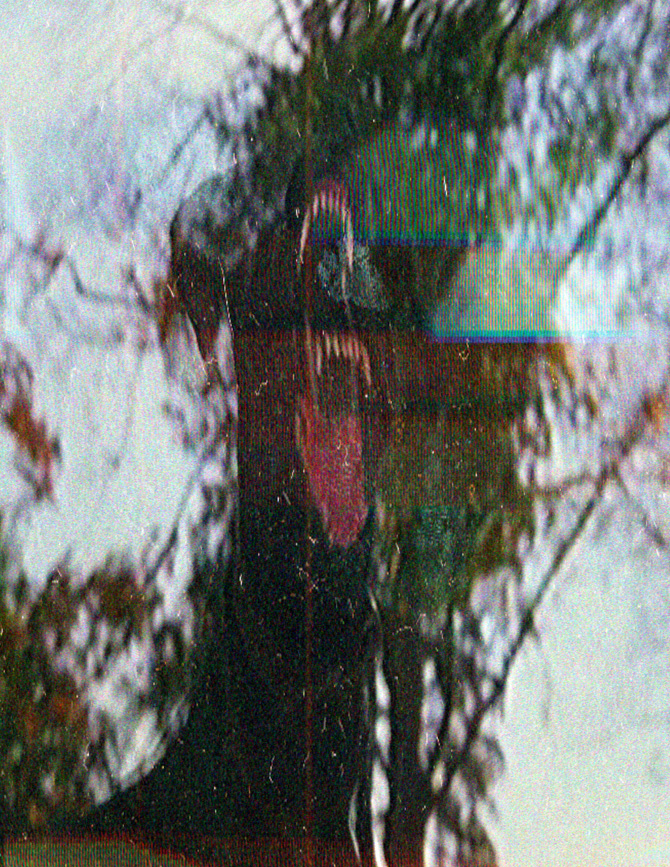

print from "Distortion II" series (2011)

Some of your latest works/videos have been inspired on the 70's progressive rock, could you tell any more about this source of inspiration and how it affects on your work. What inspires you?
I talked about this prog-rock project on Creators Project interview not too long ago. I went on and on about my prog-rock obsession, maybe too much :) so I will try to keep it brief here. You can read about that stuff there.

I just happened to be rediscovering prog-rock lately. Prog-rock used to also be called art rock, and it came originally from psychedelic rock. It sounds like a perfect match for me, doesn’t it?

I just saw in your website you have updated a 50 songs collection made from 1997 to now. Is this recompilation your audio portfolio from all these years?
I wouldn't even call it a portfolio. It’s more casual and I want to keep it pretty low-key. I wanted to archive it before I lose it. Also, maybe half of what I have in there was made specifically for my videos. So, I wanted to switch off the visuals and just listen to it. It’s just a little experiment done for my own personal reason.

Could you tell more about you career as a musician? Do you still play live music?
My childhood art tutor was a music freak. So he introduced me to a lot of music from the Rolling Stones to the Sex Pistols. He had some guitars and keyboards, things like that lying around; and my older sister is also a musician. So, I picked up playing music gradually around then. Then in my high school days, the only thing I remember is pretty much playing music in hardcore punk bands. I spent more time playing music than painting around that time. But I was making a lot of flyer art and posters and things like that then. So, that was maybe the beginning of the idea of art/music experiments for me.

I used to play live music before, but I haven’t done that in awhile. There was a time I could enjoy playing live music, but I actually don’t enjoy being the center of attention too much. The stress wasn’t worth it for me. I enjoy recording music on my own with a few friends. And lately, I mainly record music to go with my videos. So, I have no desire to pursue my music interest into a business in the regular music industry or anything. I’m sure making music wouldn’t be fun if that was my job.


print from "Electric Hair Doom" (2010)

As well as your music, focused on punk rock, psychedelic and noisy rhythms I guess is also inspired in the 70's progressive rock. How do you describe you music style?
The music I make is such a mixed bag. I have a lot of mellow, ambient music, but a lot of noisy music also. The things I listen to are totally random. I can have Chuck Mangione and Napalm Death in the same play-list, and that’s the most natural thing in the world to me. But I always have a thing for anything loud. And you know, if you look at the history of music, people have become a lot more tolerant of loud music. I mean I can’t believe that people thought the Beatles were some loud satanic music back then. We can say the same thing for art too. Just check out what we have in the art and music scene nowadays. It’s just difficult to shock people with anything now. I am guessing in 100 years; everything will be wiped. Art and music will be nothing but static.

Your visual work follows retro aesthetics, most of your videos seem to be made using analog tools, cameras, VHS, I'm so curious about what tools did you use in the past to create your first video-pieces and how are you doing it in these days. Could you say any programs, software or tool you usually uses to make your audiovisual pieces?
My setting is relatively simple actually. I do use some old analogue gear sometimes. Like one of those cheap VHS camcorder and a not so fabulous Panasonic video mixer from the 90’s. They were the cheapest I could find on ebay. Of course, I do like the look it produces. But honestly I just can’t afford to buy the latest HD equipment, is another reason. I don’t even know what the latest things around are anyway. I’m less interested in tools or techniques. So I use a lot of common software like After Effects for video and Logic Pro for music. Oh and another music app that I use often for music is called Recycle by Steinberg. It’s an oldie but a goodie. I sold most of my analog synthesizers that I used to own. I had some really good vintage keyboards, but I am not really a collector. I only want to own what I actually use, and I don’t need stuff that stays in a glass showcase.

And yes, I do like that whole retro aesthetic. But I don’t want to just carbon copy what’s been done before though. What I want to achieve is a good mix of old and new to make something totally original.


still from the video "Evil Erector" (2009)

The other day I saw in your G+ profile some really cool animated GIF. You said they were part of chatbot/game called Fred The Webmate you made back in 1998. Did you make more games like that one? Do you also write code?
Yeah, the Fred The Webmate was probably the first and the last app that I made back in 1998. A webzine Word hosted it. I learned to write it in Lingo, by myself, back then to make it. Then after that one, I realized that I have no tech background and I’m bad at maths. So that was the first and last app for me.

Fred is off-line now because it was made with Shockwave and that plug-in is almost obsolete. It’s a pain in the ass. So, I choose not to show it for now. I’m thinking about reviving it by porting to a newer platform though.

Fred was a chatterbot, sort of like the famous ELIZA. You could “converse” with Fred by typing in questions that he’d “answer” by detecting keywords. What made Fred different from ELIZA was that Fred had a graphical interface that was, I think, pretty entertaining. He appeared as an animated character—in the pixelated style of an old video game--and he did some idiotic things like getting drunk and passing out, smoking by the windows, doing push-ups etc in his little apartment. And you could talk to him about the dot-com bubble, president Clinton and Monica Lewinsky, Seinfeld, all the good things about the 90’s.


*GIF representation of the chatbot, "Fred the Webmate"

It was pretty popular for what it was back then. And luckily Fred the Webmate along with Word.com is preserved with SFMOMA and AMMI in their permanent collections which is pretty cool. And I think it was one of the earlier pieces to be archived at Rhizome Artbase. It’s still in there now with a broken link (my fault) and wrong dates and everything. But I remember being contacted by someone from there in ‘98 or ‘99.

Fred the Webmate was pretty different from the newer video stuff I do. But conceptually, it was maybe more psychedelic than anything.

Tell me more about Word.com
Word.com was one of the first webzines which utilized all things web, the whole multimedia zine experience with art, music, comics, games and original stories etc. Now the domain name “Word.com” is owned by Merriam Webster. Sadly, their site has nothing to do with the original Word.com. I was the creative director of Word. The late 90’s were such a fun time. The economy was great, and the Internet was such a booming wild west. Nobody knew what they were doing. So, artists like us could get paid to do a lot of crazy, experimental stuff.


Check here, a lot of broken links but you can get a sense of what it was. There was even a section to introduce early web art. I remember showcasing ctrlaltdel, abrusd.org, superbad.com, Marina Zurkow and day-dream.com on Word. Those guys are all pioneers of net art.

Word existed from 1995 when the web was total shit. You couldn’t design anything with it. There was no Flash, no video/audio, nothing. Not even not animated GIFs. Just static GIF images and text with grey background and bad layout options. I don’t even know if anyone would remember the time when GIF animation was not supported by any browsers, back in 1996, until Netscape 2.0 came out. Before that, we used to use this ancient CGI script called client pull/server push to do pseudo animations. We were one of the first people to do animations on the web. So we used to get a lot of attention back then. Word Magazine was shutdown in 2000. And damn, all these stories make it sound like I’m 100 years old. It was not that long ago. Don’t worry, I’m not that old. I just started out young and early. The Internet technology has changed from night to day in only 15 years, and I guess I’ve witnessed all that.

While we have been doing this interview, you have posted some incredible GIFs again on G+. They seem to be from a some generative tool, I really like how they move and the colors you selected for. What could you say about their design and the way for animating them?
Some people have asked if those are done with some crazy code with Processing and stuff. But I actually just use After Effects to make those. Those are just done with a careful choice of colors and a lot of weird combinations of effects and keyframes in After Effects. It looks sort of random, but it's done in a pretty controlled environment.


I had never saw any GIF from you. I started to see them at G+. Have G+ and the group GIFfers who are living there :) induced you to work on this kind of format?
I used to produce a massive amount of GIFs in the late 90's for Word.com. Word had this thing called "Word TV" which sat on the corner of the Word.com homepage. It cycled through hundreds of tiny GIF animations like a TV channel. And those were all made by Word staff, me included, and a lot of contributors. Then after Word.com got shut down, I sort of shifted my interest to video. I actually never cared for GIFs for a long time. Those GIFs you saw on my G+ originally came from my video experiments, just optimized as GIFs.


I know a lot of artists get passionate about GIF animations these days. I think it's cool. I can tell you that mine have no deep philosophical meaning behind them. Those are just for fun, and those GIFs on G+ helped me to meet some new talented artists. So that was already a good enough reason to make those. And I like G+ because it seems to be more graphically engaging than the other social media sites. I guess I'd rather communicate through visual things.

As we can see in your website, your first piece is from 2001. Your work has followed a path very uniform, marking a clear style and aesthetic based in digital manipulations, distortions, noise and psychedelic colorful visual effects, What can you tell about your trayectory in these 10 years? What do you think, has changed anything in your work in all this time?
I have a bunch of older things before 2001. Maybe I should try to put some of that up one day. But unfortunately, a lot of the Internet based artworks I made before 2000 don’t work because I used to use a lot of Shockwave plugin etc, and it’s just old, obsolete technology. Plugins suck. Don’t rely on them. I learned that the hard way.


print from "Distortion" series (2010)

One thing I can tell you is that I‘ve tried a lot of different things. I’m not always 100% happy with what I make. So, each time I challenge myself to outdo my older stuff. And I’m still going like that. I think part of the most important aspect of my art practice is to keep producing. Whether I think my work sucks or not, it is more important to keep making things than worrying about it. I have some stuff I made in the past that I am not particularly proud of. In fact, some of those are sort of ridiculous in retrospect! But that’s ok. It’s all just part of the big picture. And in the end, the ultimate goal is to make stuff that stands the test of time.


still from the video "Devils Reign" (2010)

Tell me about your recent/future activities please. You had a solo show in spring?
Yeah, the solo show was in Stockholm, Sweden. An art gallery called Galleri Jonas Kleeup. I mainly showed my prints this time. They are sort of like video prints. Then I have a retrospective screening at Rojo/Nova in Sao Paolo on October 8th. They will be showing about 15 different psychedelic/noise videos that I created over the last decade. It will be an hour program. Then I will be in a group show at a gallery called The Popular Workshop, in San Francisco in November.

I’ve also been working on 2 video albums. One is almost ready, and it will be called “Distortion III”. It is another noise video album. It will be published by a label in L.A. called Table of Contents. Then I will keep on working on the other bigger scale prog-rock inspired video album called Sibyl with my friend Daron Murphy. I’ll be showing some of the new pieces from Sibyl at Rojo/Nova.

How do you describe the concept “video album”
The way I have been using the term video album is that it’s basically like a traditional music album, but it comes in the format of digital videos. And the music and video are both produced by the artist. They are definitely not music videos, since that implies promo videos for a band’s music in a traditional sense.

I like having my video experiments in one package with a bigger concept and then presenting it. Not just showing little experiments piece by piece randomly.

And you know, this work I do has no obvious market. It’s neither exactly for the music industry or the art gallery scene or the net art scene. So it’s sometimes hard to find the right outlet for it. But I’m not able to make an adjustment just so that I can fit into a group. I mean I actually don’t know how to. So I just keep going with it and see what happens. Luckily I’ve been with labels, publishers and art galleries who want to distribute and promote my videos albums. Also, a lot of people invite me for screenings. It’s never been on a huge scale but I’m still lucky to have people that are supportive.

Tell us about your past video album releases.
I’ve had 3 video albums releases in the past. The most recent one is called Video Metal in 2009. The funny story about that one is that I got a pretty bad review and possibly the best review ever at the same time. It’s fun to read them. And I’m ok with the bad review since I sort of expected that. I mean I knew Video Metal was juvenile and just obnoxiously noisy. I didn’t mean to make a smash pop hit. Just look at the title of that thing. I totally knew that a lot of people would be weirded out by it. I knew what I was doing. I don’t like to take myself too seriously. But the reviews were so serious, and it was almost funny. And in the end, reviews in general for art or music, whether the good ones or the bad ones don’t really matter since nobody can really put scores on art and music. It’s not fucking sports. Who cares what people say because it’s all subjective. And you know that popularity doesn’t mean quality, right? Just look at the American top 40 chart or turn on MTV. The majority of people love crap. So, that’s a comforting fact for any artists who make weird shit. Or is that my excuse for a lot of my stuff!? I mean being different is a good thing.

The other two video albums are compilations of noise/music videos. One is from 2001, and the other came out in 2006. I have shown those two at many screening events. Those were all DVDs. DVD technology was a hot thing in 2001, but it’s already going extinct. So, I am talking to my label people about trying out digital video download for my new release.


still from the work in progress untitled video (2011)

I was thinking about the japanese animated culture, many japanese artists I guess have been really inspired by the huge animated cartoon filmography from other japanese animators and artists, making trippy and crazy animations. Many of these cartoon series show us lots of psychedelic effects. Have you ever been inspired by this kind of animations or other similar sources from the japanese culture?
Yeah, I’m sure. Japanese pop culture influenced me, but maybe subconsciously. I actually wasn’t really into japanese manga/anime stuff as much as the other kids were. Or maybe I pretended not to be interested. I kind of wanted to avoid that whole nerdy stuff since I was a poser dude who played guitar in bands :) I was such an ass. Or maybe I’m totally lying now. I loved this perverted comic called Gaki Deka as a kid. That one is pretty genius.

The thing is that in Japan, you can’t avoid manga/anime culture because it’s everywhere. So, I’m sure I absorbed it. I just try not to be a guy who makes stereotypical Japanese freaky cartoon art. I like being subtle and unexpected with everything.

Have you seen that Internet meme, “Japan, Producing 78% of the worlds weird shit, since 1952”? I think that’s pretty accurate and really awesome.

Tell me about the video “Violet Dark Spring of the Numinous Orb” that you are premiering with us at Triangulation Blog.
This is one of the pieces from the series Sibyl. It’s the first one my music partner, Daron Murphy, and I made. It was actually premiered at the New Psychedelica at MU in the Netherlands this spring. So, we should call this officially an Internet premiere. It’s a lot mellower piece than what I usually make. It’s sort of channeling Miles Davis. And I think it’s still got that intense psychedelic feel. I know people on the Internet are inpatient and probably won’t watch the whole thing. You, I know you! But I still recommend watching the entire thing with headphones on. It gets trippier toward the end.

(Recommended full screen)


Thanks Yoshi!